Who Has to Attend
Unless the law gives a specific exemption, a child who is at least 6 years old (or younger and already enrolled in first grade) must attend school until their 19th birthday. Pre-K and kindergarten students must also attend once they are enrolled. If a child is under 6 on September 1, a parent may withdraw them without breaking the attendance law.
A student who keeps attending after turning 19 must also attend every day.
TEA handbook §3.5, p. 57; Texas Education Code §25.085
Earning credit
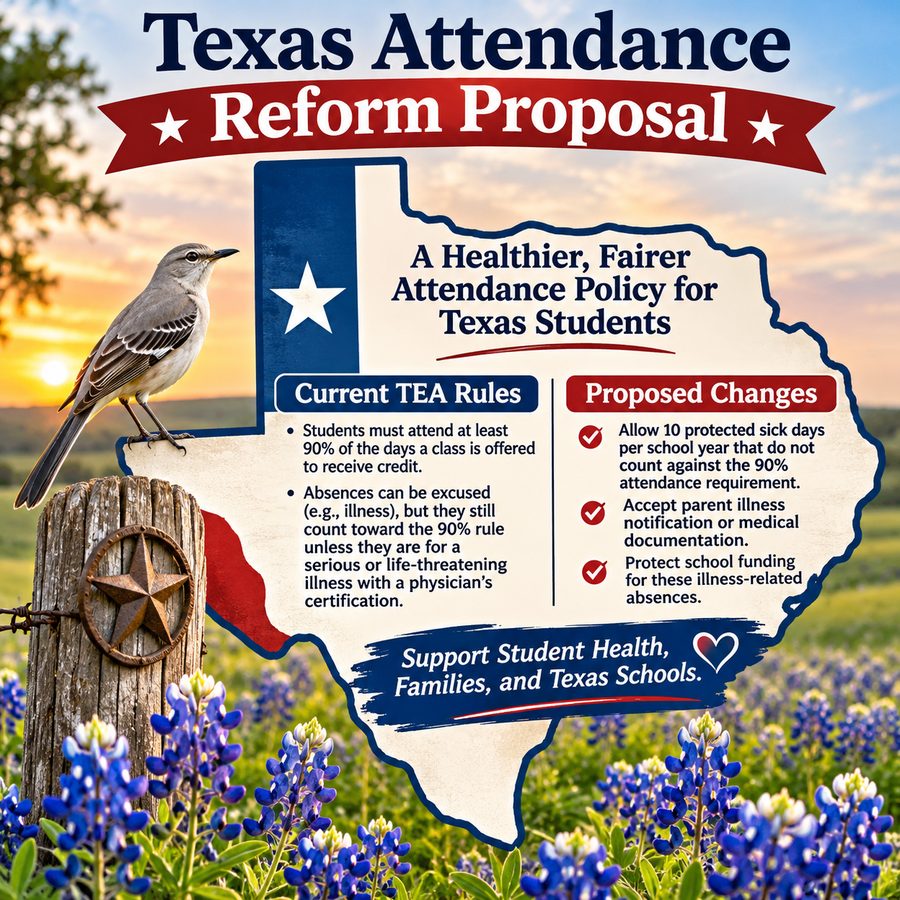
The 90% Rule
To receive credit or a final grade for a class, Texas students generally have to attend at least 90% of the days the class is offered. This is a separate question from whether an absence was excused. The TEA handbook says it plainly: "Numerous absences, whether excused or unexcused, may jeopardize a student's ability to receive credit or final grades for classes."
The student meets the attendance requirement for credit.
The student can still earn credit by completing a plan approved by the principal, such as makeup work or extra instructional time.
The student generally loses credit unless the campus attendance committee decides there were extenuating circumstances and sets a plan to earn it back.
Texas Education Code §25.092, cited in the TEA handbook §3.6.3 (p. 66) and §3.6.4 (p. 67). Absence counts are rounded and for illustration; credit is usually decided class by class.
What "excused" really means
Excused vs. Unexcused Absences
Parents often hear one word, "excused," used for three different things. Knowing the difference explains why a sick-day note doesn't always protect a student.
The School Accepts the Reason
A teacher, principal, or superintendent may excuse an absence "for any reason acceptable" to them. This keeps the absence from being treated as truancy. Ordinary illness with a parent note usually falls here.
A Reason Listed in State Law
For a short list of reasons in the law, the student is counted as present for the day. These are the only absences the state treats as attendance, and the school must keep documentation.
No Accepted Reason
An absence the school does not excuse. Ten or more days or parts of days within six months in the same school year is truant conduct for students ages 12 to 18.
An ordinary illness like a cold, flu, or stomach bug is not on the state's list. The school can excuse it, but the student is still counted absent, and the day still counts toward the 90% rule.
Reasons a Student Is Counted Present
When a student misses school for one of these reasons and meets the requirements, the state counts them as present.
| Reason | Key requirements | Limit |
|---|---|---|
| Doctor, dentist or mental health appointment | Student must start or return to class the same day. Needs a note from the provider. Telehealth visits count. A visit to the school nurse does not. Includes autism services such as speech, occupational or ABA therapy. | Part of a day |
| Serious or life-threatening illness | Physician certification on the district's form. See details below. | Period the doctor states |
| Religious holy days | A parent note is enough. Schools may not require a note from clergy. Retreats, camps, mission trips, baptisms and similar events don't qualify. | Plus 1 travel day each way |
| Required court appearance | Jury summons, subpoena, "must appear" ticket, or a case where the student is a party. Probation meetings don't qualify. | Plus 1 travel day each way |
| Visit with a deployed military parent | Parent, stepparent or guardian on active duty, deployed at least four months. Within 60 days before deployment or 30 days after return. | Up to 5 days a year |
| U.S. citizenship paperwork or naturalization ceremony | The student's own application or oath ceremony. | Plus 1 travel day each way |
| College visits | Juniors and seniors, following district policy. | 2 days each year |
| Career investigation visit | Juniors and seniors visiting a professional's workplace. | 2 days each year |
| Military enlistment | Age 17 or older. | 4 days during high school |
| Driver's license or learner permit | High school students age 15 or older. | 1 day for each |
| Election clerk | Age 16 or older, with principal's consent. | 2 days a year |
| Playing "Taps" at a veteran's funeral | Grades 6 to 12, funeral held in Texas. | None listed |
| Released time religious instruction | Off-campus course, with a parent request on file. | 1 to 5 hours a week |
| Court-ordered activities for students in foster care | Students in DFPS conservatorship, when the activity can't be scheduled outside school hours. | Plus 1 travel day each way |
TEA handbook §3.6.3, pp. 60–66; Texas Education Code §25.087
Makeup Work
For most of the reasons above, the school must give the student a reasonable amount of time to make up missed work. If the student completes it, the day counts as a day of attendance for the compulsory attendance law.
Tardies
Tardies generally are not counted as absences when enforcing the compulsory attendance law.
Each district adopts its own tardy policy. Check your student handbook for details on how tardies are handled in your district.
TEA handbook §3.5, p. 58 and §3.6.3, p. 66
When your child is seriously ill
Serious or Life-Threatening Illness Certificates
If a serious or life-threatening illness, or its treatment, makes it impossible for your child to attend, those absences can be counted as attendance. You provide a certification from a physician licensed to practice in Texas, on a form your district adopts.
What the Physician's Certification Includes
- The student's illness
- A statement that the illness is serious or life-threatening
- How long the student is expected to be absent because of the illness or treatment
- A statement that the illness makes attending school infeasible during that time
Your district must adopt a form for this, and it cannot require more documentation or information than these four items.
Long-Term or Recurring Conditions
A student with a chronic illness or long-term health problem who will be confined to home or a hospital for at least four weeks may qualify for General Education Homebound services, where a teacher provides instruction at home. This includes conditions that come and go, as long as the time adds up to at least four weeks in the school year.
When the student is ready to return, a homebound or Section 504 committee sets a transition period based on current medical information.
Students with a 504 plan or an IEP who miss a lot of school should have their committee meet to plan for absences and prevent truancy.
TEA handbook §3.6.3, p. 65; §3.6.4, p. 67; §3.7.6–3.7.7, p. 73
Questions parents ask
Common Questions
My child had the flu and I sent a note. Does that day count against them?
For the 90% rule, yes. The school can excuse the absence, so it isn't treated as truancy, but ordinary illness isn't on the state's list of reasons a student is counted present. The day still counts as a missed day.
What if I take my child to the doctor in the middle of the day?
If your child goes to school before or after the appointment on the same day and you bring a note from the provider, they are counted present. Telehealth appointments count too.
My child has a chronic condition. What should I ask the school about?
Ask about General Education Homebound services if your child will be out at least four weeks in total, and about a Section 504 plan if your child doesn't have one. For a serious or life-threatening illness, ask for the district's physician certification form.
What happens if my child drops below 90%?
Between 75% and 89%, your child can usually earn credit by completing a plan the principal approves. Below 75%, the attendance committee decides whether there were extenuating circumstances. Talk to your campus attendance office early.
Who decides what counts as acceptable documentation?
The state sets the rules above, and each district writes a local policy for what documentation it accepts. Check your district's student handbook or ask your attendance clerk.